The full, uncut memoir is on the Burnham Hub archive page at /archive/isaac-harvey, shared with the family's blessing. This is the long read: what Isaac wrote, with a few facts from the town's records alongside. Where something is only Isaac's account, I say so.
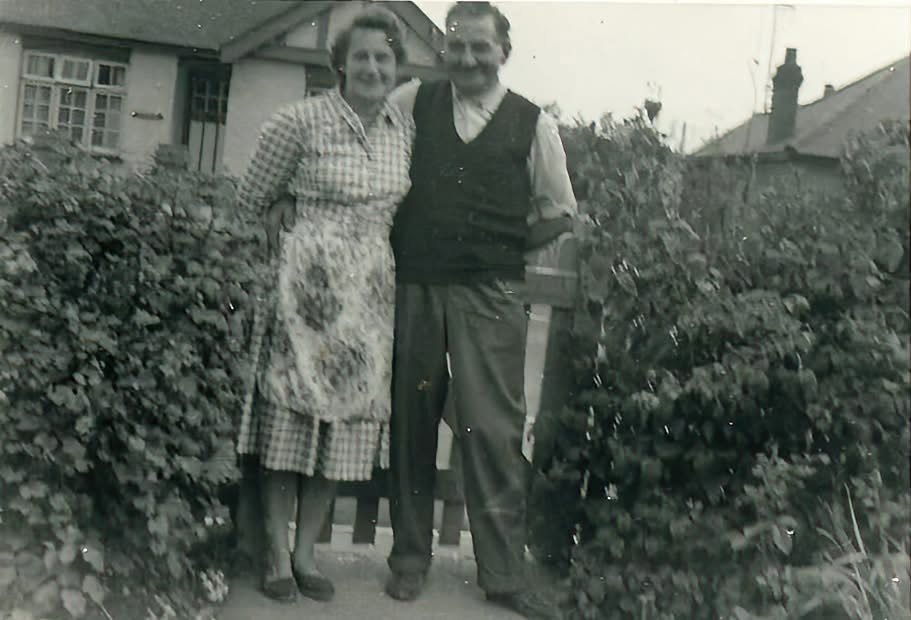
!Isaac George Harvey with his wife Ivy. Shared with Burnham Hub by the family.
1. The Burnham most people write about
If you pick up a guide to Burnham-on-Crouch, you mostly read about the yacht clubs. The Royal Corinthian moved its headquarters here in 1892, the Royal Burnham was founded in 1895 and Burnham Week began in 1893. The Corinthian clubhouse on the Quay, designed by Joseph Emberton in 1931, is Grade II* listed. All true, and all worth knowing.
It is a different town from the one Isaac George Harvey remembered. He was born in Essex Road in 1903, the eighth child and third son. His father was one of the Harvey Brothers, who ran pleasure boats in the summer and took winter jobs like cleaning up yachts. Isaac lost most of his hearing to scarlet fever as a small boy, worked in a foundry, on farms and in a bakery, and wrote his memories down many years later. He gave them the title Memories of Burnham-on-Crouch.
The family have shared that memoir with Burnham Hub. I have not tried to prove or disprove it. What I want to do here is pass on what he wrote, in his words wherever I can, and mark clearly what is his and what is mine.
2. Essex Road, the Pits and Titty Ball Mansions
Isaac's Burnham is a small one. He says the town had about 3,000 people, and that it had about 18 sweet shops, 6 bakers, 6 butchers, 12 grocers, 8 greengrocers and 3 policemen who "were seen and heard".
He remembers where the houses now are as fields. Essex Road had a shady path, and the north end led to the gravel pits, which he describes as a beautiful place for anyone who could see it, with furze and blackberry bushes, a pond that froze for skating, and boys fishing for tiddlers. Albert Road, he says, was a cornfield. What is now St Mary's Road was apple orchard. He notes the Catholic Church was built around 1912 or 1913.
He also describes a building on what is now Orchard Road:
"The Coastguard houses were built before the century and on the other side of the road which is now Orchard Road there was a large wooden building which was called Titty Ball Mansions which housed four large families, and on the other side of Orchard Road was fields of gooseberry and currant bushes."
Isaac G. Harvey, Memoir, P003
I have found nothing else about that building or its name, so it stays Isaac's recollection. It is a good detail all the same, because it says plainly where some of some of the poorest families lived.
He is blunt about money too:
"Families were large in those days 10 or more and there was great poverty."
Isaac G. Harvey, Memoir, P006
Prices before 1914, as he remembers them: butter at a halfpenny a pound, sugar at 2½ or 3 pence, eggs a penny each, a 4lb joint of beef 4s 6d to 5s. A 20 inch strip of liquorice cost a farthing. He then adds that wages were so low that people did not have what we have today, only the rich. A woman in his road once gave him a halfpenny as a Christmas box. The lady next door gave him a shilling, and that, he says, started his savings book.
On farm wages he gives two figures that are worth setting side by side. Before the First World War, farm wages were 20 shillings. In another place he writes that farm workers got 30 shillings a week for about 60 hours, 6 am to 6 pm on weekdays and 6 till 1 on Saturdays. He says wages rose during the war and then went back down to 30 shillings. His wording is loose, so I would treat the figures as his memory, not a table of rates.
School comes up often. He writes that once a year health men came and the children walked in single file while they were sprayed with disinfectant. Children came in from the marshes in a covered wagon, and those from Fambridge and Althorne by train. Some came in rags, with feet showing through their boots. Classes, he says, were between 46 and 50.
In the school holidays he picked fruit: raspberries at a halfpenny a box, currants at 6d a sift, on what is now the Maldon Road, which then had hardly any houses.
3. Deaf in a classroom
Isaac was knocked down by a horse and carriage in Crouch Road when he was about three, then had scarlet fever. He wrote that it took his hearing "except a bit", and that he lived with loud noises in his head. He also had measles, mumps and chicken pox within a year.
What he writes about school is hard to read. He says he was caned for not answering when a minister spoke to the class, because he could not hear it. He says a teacher knocked his head when she passed his desk. He says he was put back a class. His own words are that he left school at thirteen and a half.
His mother died when he was ten. A year later the Great War started. His sister Doris looked after the family until their father married again in February 1920, and then the family broke up and Isaac went into lodgings.
One small memory I keep coming back to. At Christmas the Salvation Army and the Burnham Mariners would play carols outside the house in Essex Road, and his mother would wake the children so they could look down from the top bedroom. He wrote that although he could not hear, he heard his mother say it was beautiful.
4. The Harvey Brothers on the water
His father's trade comes through clearly. Isaac wrote that the Harvey Bros started with his father and were later joined by his brothers. The memoir says four brothers in one place and five in another, so I will not give a number. They hired out boats and ran summer trips in sailboats called the Favourite and the Waterlilly, and in a motorboat, the Queen Mary.
"Mrs W Smith's was a lot of buildings for boats belonging to the Harvey Bros which was started by my Father and later joined with his 3 brothers."
Isaac G. Harvey, Memoir, P015
He also says the Harvey Brothers won a large silver cup at a Burnham regatta, which sat in a glass case at home. He did not know what happened to it after his father married again. On Fridays up to 1923, he says, his father took his boat to Foulness loaded with meat for the island.
His father, he wrote, was a Tory "not really by choice", because he relied on his landlord for the boatyard and for winter work. They worked hard, he says, and retired fairly comfortable, except his father, whose money and house went by degrees after he married again.
There is one other recording to mention. The Essex Record Office holds a 1975 oral history interview with Fred and Daisy Harvey (reference SA 5/386/1). I have not found anything that says how, or whether, they were related to Isaac, so I am not using it here.
5. Dunkirk: Isaac's account
The Dunkirk line comes from Isaac's paragraph about the family boats:
"My cousin George helped with the motor boat and after years with the coming of WW2 he took the boats to Dunkirk and helped with the troops return."
Isaac G. Harvey, Memoir, P033
That is a cousin called George, not Isaac himself. This part of the family story is contested, and I have not seen anything that settles it either way. Please read it as what Isaac wrote.
6. The foundry
Isaac's first job after school was at Cranfield and Carters. He says he was there two years and was dismissed after being blamed for a bad job that was not his work. He then went to the foundry, got very depressed and ran away to London. That was the night the Zeppelins came over, he says, and he came home the next day. At 15 and a half he took a job at Smiths, the bakers, for 11 shillings a week with breakfast and tea, and he says the breakfast was stale bread with margarine and a "winey jam". He went home to eat. In November he was dismissed when they took on an ex-soldier. He then worked as a gardener at the Old Vicarage for 12 shillings and as a milkman for 18 shillings before going back to the foundry on piecework, where he says he did very well.
The foundry was on Foundry Lane. Burnham Hub's own research notes say Booth and Brookes, the Mildmay Ironworks, was founded there in 1899. They cast frames for Broadwood and Chappell pianos, Mills bomb casings in the First World War and ASDIC domes in the Second, and closed in 1980. In 1921 the foundry cast the bronze wreaths and name plaques for the town war memorial, which was dedicated on 14 August 1921. Isaac only calls his workplace "the foundry", so I am reading the two together and cannot prove it is the same one.
What I can quote is why he left. In 1927 the foreman, he says, had him make Crittall window frames at the same price he had been paid for other work:
"I told him it was impossible to make them at a penny each. I thought he said do it day work so I did and only got 17 shillings. So I went after him and told him what he could do with his job."
Isaac G. Harvey, Memoir, P060
That day was 5 March 1927. He went home and told his sister he was going to London to book his passage to Australia.
7. Australia, and back
Isaac wrote that a dream at five years old convinced him he would go to Australia. He tried at 17 and 18 and was turned away because he was deaf. At 23, he says, he paid £38 at Australia House in the Strand. He sailed in the spring of 1927 from Tilbury on a ship he spells "Beltona", sharing a cabin with four others. He names a friend, Walter Vine, who was an assisted passenger.
He says that in Perth he saw crowds lining a street and was told the Duke and Duchess of York were coming. He wrote that they were the couple who had spoken to him on the boat. That is his story, and I have not checked it.
In Western Australia he worked on a wheat and sheep farm and put on a stone and a half. After about six months he went to Queensland, to relations at Warwick, where he found a dairy job he called slavery: 4 am to 8 pm, 240 cows, with milking machines. He ended up in hospital with exhaustion. Later he went out into the country for peanut hulling, and then went on to New South Wales. He writes that being deaf was "a terrible handicap" and that employers always found an excuse.
He tells of sleeping rough in Sydney under a tree and being moved on by a policeman, and he says he saw the beginning of the Sydney Harbour Bridge. A registered letter from his father with £2 10s, and an offer to get him onto a boat home, got him back. He writes of about eight weeks afloat.
8. Home, Ivy and Burnham again
Back in England he lived with his sister at Blackmore, took labouring and cowman jobs, and went to a whist drive at Highwood. On the way home he met a girl who was afraid to go back through the woods alone. She was Ernie Riglin's sister, and her name was Ivy. They married on 10 January 1931. He writes of 51 years of married life that came to an end on 4 March 1982. He wrote that after the war he was given a hearing aid, and that it helped a great deal. He says he has not had depression for all of his married life.
Isaac came back to Burnham in 1954. His comment on the town he returned to is a good place to stop:
"I went away in 1927 so when I came back in 1954 Dunkirk, Alamein and Arnhem Roads were built also Normandy Avenue, so to this day estates have sprung up and old houses have either come down or rebuilt and greatly improved."
Isaac G. Harvey, Memoir, P033
9. What this is, and what it is not
This is one man's memory, written down late in life, and it has to be read like that. What he says about the Dunkirk boats, about the royal couple on the ship and about the name of that Orchard Road building are things he wrote down, and I have not been able to check them.
The text I am working from is a transcription. A few short passages in brackets, such as in P050, P055 and P066, are later notes from a family member, not Isaac's words, and I have left them out of this article.
If you know anything about the Harvey Brothers, the boats or the foundry, or can correct something here, please get in touch through the Burnham Hub Page. The full memoir is at /archive/isaac-harvey. My thanks to Lynda George and the Harvey family for letting us share it.